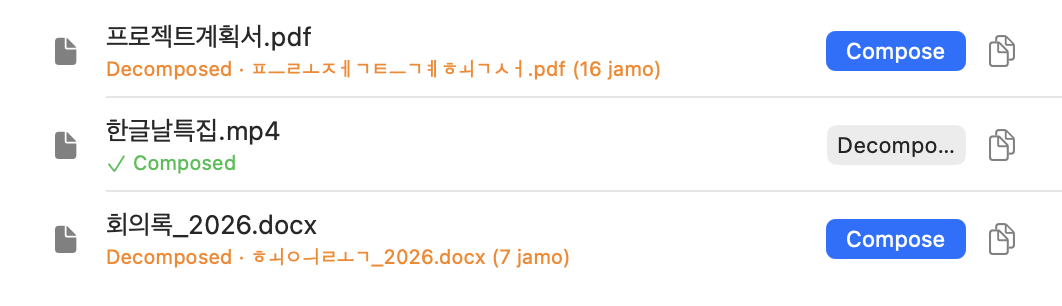
Compose and decompose, and NFC/NFD
Compose and decompose, and NFC/NFD
What problem does this solve?
macOS stores filenames with decomposed Unicode (NFD) on disk. When those names travel to another OS (Windows, Linux), to cloud storage, to a server, or into a zip archive, they often render as broken-looking sequences of jamo / combining marks, or stop matching searches and sort orders.
JamoMoa rewrites those filenames into their composed (NFC, precomposed) form. The Korean name “자모모아” literally means “gather the jamo back together”.
What’s the difference between Compose and Decompose?
They’re the two directions of the same canonical mapping:
- Compose turns a split-apart NFD name into its NFC (precomposed) form — the fix for the macOS filename problem above.
- Decompose does the reverse, turning an NFC name back into NFD.
JamoMoa can do either on any file, in any order, and the bottom bar offers Compose All / Decompose All for the whole list. Because NFC ⇆ NFD is lossless, converting one way and back returns the exact original bytes.